

After 90 minutes of play, with the Colours up 6-1, the fate of the match appeared all but sealed.
The Colours had effortlessly dominated the match, playing some of the best football seen in recent times at Hyde Park.
Driving the team was a formidable Gregorio, in full control of defence and midfield. He arrived on each ball before every opponent with timeliness, touching it with grace and strength. He is often compared to Arsenal’s Calafiori, but on the pitch he looked more like a young Maldini infused with Gattuso’s energy and Pirlo’s precision.
On their attacking side, Oliviero was in stellar form, cutting through the Orange defence like a Japanese knife on a piece of butter, despite Federico’s heroic efforts to keep him, Bijan and Julien far from the goal. But truly everyone in the Colours team, from Paride to Julien, deserves accolades for playing in a highly focused and unselfish way, supporting and high-fiving each other even when a play went wrong.
On the other side was an Orange team unable to express their full potential. Players like Dario, Oscar, Andrea and Ross have incredible talent, but somehow they were not delivering, lacking precision in the critical moments. Few of their team members made things worse by pointing fingers and complaining to teammates making mistakes rather than encouraging them, hardly a recipe for success.
Only towards the end, a player swap was agreed, with Adam joining the Oranges and Davide moving to the Colours. A spirited Adam gave the Oranges a much needed boost in attack, but it was too late to turn the game around. while Davide, who had been criticised in the Colours team for failing a simple throw, managed to show his potential as soon as he swapped side.
The Golden Goal offered redemption opportunity but it was not going to be this time. Oliviero scored it with a spectacular volley shot from long distance, reminiscent of Van Basten’s historic goal in the 1988 Euro final. A feat that sealed the score at 7-1, putting an exclamation point to the story of Colours’s domination, and allowing him to bring home the MOTM award.
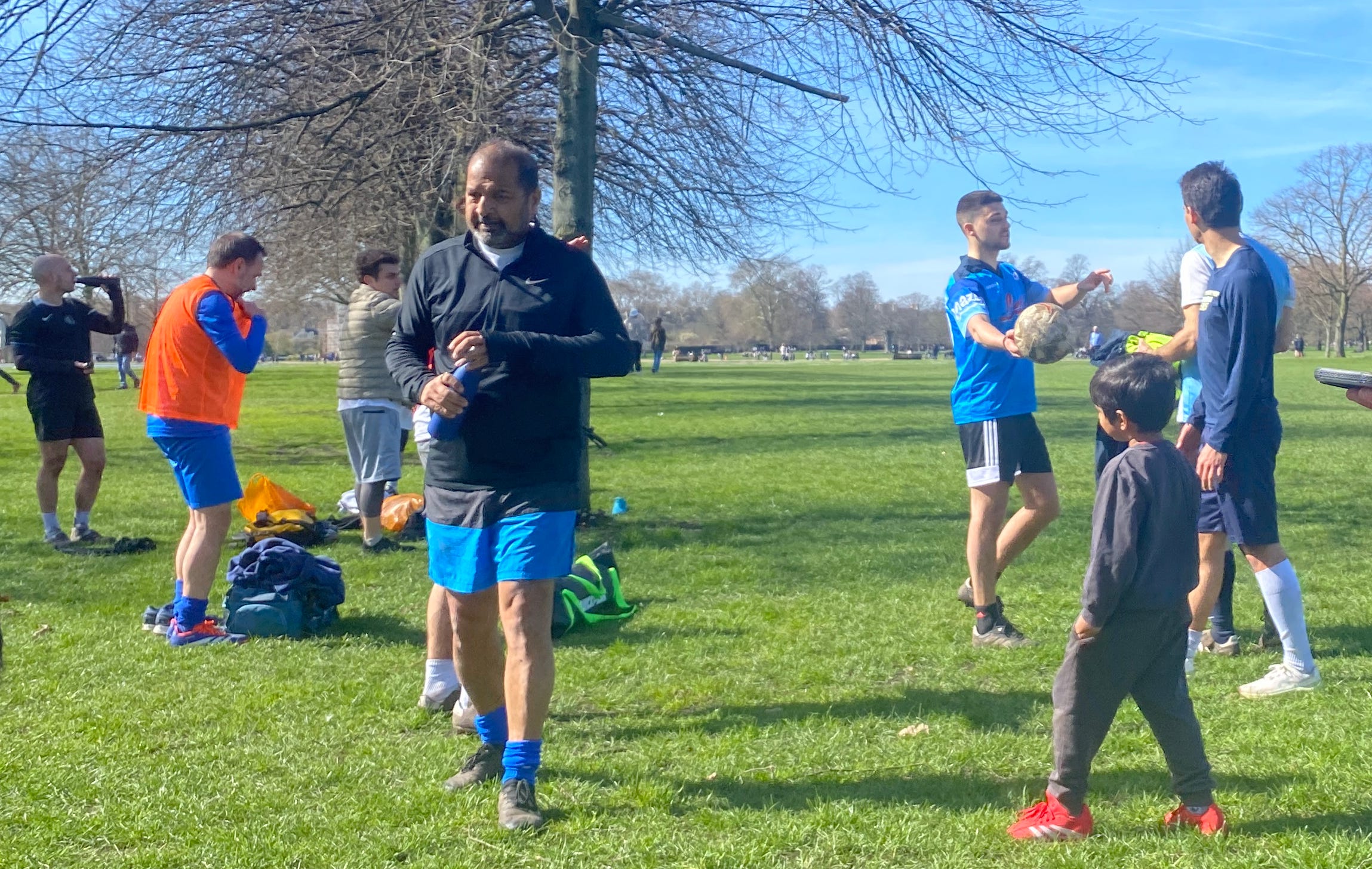
With such disparity evident, and not for the first time, questions were asked about the efficacy of the algorithm used by Hossam to select teams. An instant investigation revealed a shocking truth: the logic adopted by the egyptian is not based on quantum physics or agentic AI or anything like that. In fact it uses only one, rather unsophisticated parameter: how distant a player is from him.
“What I do is hand bibs to the first eight guys I see, and then adjust from there” admitted Hossam with a smile, something referred in academia as the “proximity algorithm”, albeit adding that he should have corrected things mid way when the disparity was evident.
In a later meeting of the FD Board, it was decided that for the next match a new team selection method should we tried. Among the tools being evaluated are Bayesian optimisation, neural networks projections and predictive modelling based on eXpected Goals and hairstyles.
Or perhaps an easier way would be to just give the task back to Hannes, who in the past has proven the ability to easily create perfectly balanced team on the spot with uncanny teutonic precision.